Gestão do Ciclo de Receita: Por que a IA Agentic é a resposta para $140 bilhões em desperdício

Equipe Moveo AI
in
🏆 Insights de Liderança

No atual cenário macroeconômico da saúde, a excelência clínica se tornou apenas uma parte da equação da sustentabilidade. A outra metade, muitas vezes subestimada até se tornar uma crise, é a saúde financeira da organização. No centro dessa batalha está Gestão do Ciclo de Receita (GCR).
Durante décadas, a gestão do ciclo de receita foi tratada como uma função operacional de escritório. Hoje, ela ascendeu à agenda estratégica das diretorias administrativas.
A razão é puramente matemática: de acordo com pesquisa da McKinsey, os sistemas de saúde coletivamente gastam mais de 140 bilhões de dólares anualmente em processos manuais e tecnologias fragmentadas. O processo típico de GCR consome 3% a 4% da receita líquida de um sistema de saúde em escala.
No entanto, estamos enfrentando uma mudança de paradigma. A era da automação baseada em scripts simples acabou. Estamos entrando na era da IA Agente, uma evolução tecnológica que promete desbloquear o primeiro caminho credível para um ciclo de receita verdadeiramente "sem contato" (um sem intervenção humana) e reduzir o custo de coleta em 30 a 60 por cento.
O Ecossistema RCM: Onde a receita é perdida?
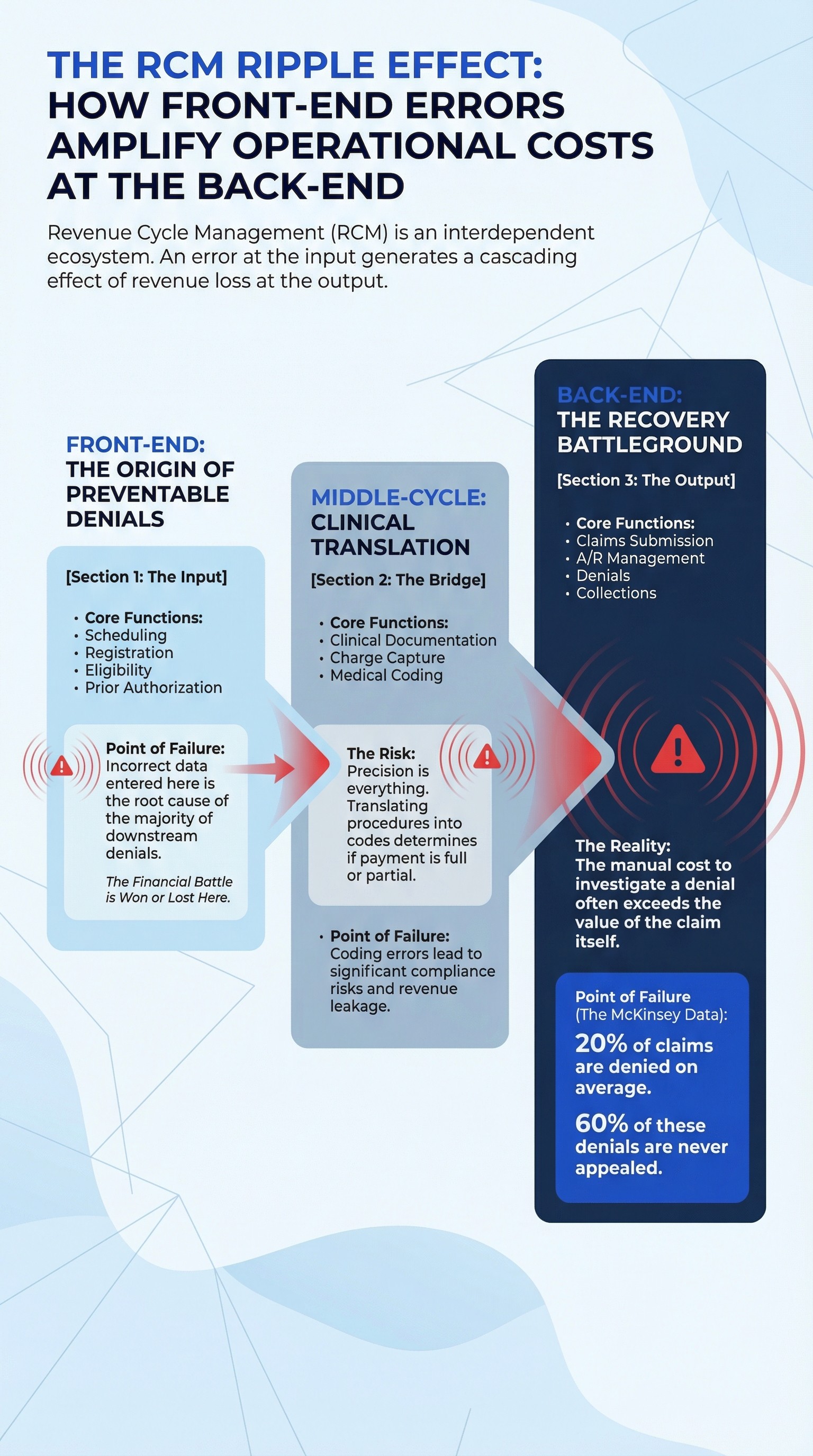
Antes de entendermos IA Agente, precisamos primeiro compreender a complexidade do ciclo atual. O RCM não é monolítico, é um ecossistema de funções interdependentes onde um erro na entrada gera um efeito cascata de perda na saída.
Imagine o ciclo como uma linha de produção industrial de alta precisão, dividida em três etapas críticas:
1. Front-End: A Origem das "Negativas Preveníveis"
O ciclo começa muito antes do encontro clínico. É nesta fase de Acesso ao Paciente que a batalha financeira é frequentemente vencida ou perdida.
Componentes Críticos: Agendamento, Registro, Verificação de Elegibilidade e Autorização Prévia.
Ponto de Falha: Esta é a etapa mais crítica. Dados incorretos inseridos aqui são a causa raiz da maioria das negativas subsequentes. A complexidade dos planos de saúde e a falta de integração em tempo real transformam a autorização prévia em um colossal gargalo administrativo.
2. Ciclo Médio: Tradução Clínica
Esta é a ponte entre os cuidados médicos e a cobrança.
Componentes Críticos: Documentação clínica, captura de cobrança e codificação médica.
Ponto de Falha: É aqui que a medicina encontra a burocracia. A precisão na tradução de um procedimento clínico para um código (como ICD ou CPT) define se o pagamento será total ou parcial. Erros de codificação geram riscos financeiros e de conformidade significativos.
3. Back-End: O Campo de Batalha da Recuperação
Onde a execução financeira ocorre.
Componentes Críticos: Envio de reivindicações, gestão de contas a receber (A/R), gestão de negativas e cobranças.
Ponto de Falha: É aqui que o dinheiro fica preso. Atualmente, cerca de 20% das reivindicações são negadas pelos pagadores. Os dados mais alarmantes da McKinsey revelam que 60% dessas negativas nunca são apeladas. Por quê? Porque o custo manual para investigar e apelar a negativa geralmente excede o valor recuperado.
Desafios da Gestão do Ciclo de Receitas: Por que a Automação Tradicional Falhou
Se a gestão do ciclo de receita (RCM) é tão crítica, uma pergunta difícil deve ser feita: Se bilhões foram investidos em RPA (Automação de Processos Robóticos) na última década, por que a indústria ainda está perdendo $140 bilhões anualmente em ineficiências?
Desafios persistentes na gestão do ciclo de receita decorrem da natureza das ferramentas legadas. A RPA tradicional se destaca em tarefas rígidas e repetitivas, mas falha quando confrontada com variabilidade.
Se um portal de pagador move um botão, o bot para.
Se uma negação requer interpretação clínica de registros médicos não estruturados, o bot falha.
O resultado é um processo fragmentado onde humanos atuam como "cola" entre os sistemas, realizando tarefas de baixo valor enquanto a inteligência estratégica é consumida pela burocracia. Isso nos leva a métricas insustentáveis, como um custo de coleta estagnado de 3-4% da receita líquida e uma escassez crônica de codificadores e analistas médicos.
Saiba mais→ Cenário de Delinquência dos EUA 2026: Dualidade de Crédito e o Papel da IA Agente
Uma mudança de rumo? O que os dados dizem (2023 vs 2025)
Líderes do setor de saúde estão reagindo. Dados recentes da McKinsey revelam uma mudança drástica nas intenções de investimento tecnológico. A busca por soluções pontuais está dando lugar a uma demanda por plataformas integradas e inteligentes.
A tabela abaixo ilustra onde os líderes de RCM estão alocando seu capital político e financeiro:
Função RCM | Prioridade em 2023 | Prioridade em 2024 | Prioridade em 2025 (Projetado) | Tendência |
Autorização Prévia (Front-end) | 35% | 44% | 60% | Crescimento Acelerado |
Codificação (Ciclo médio) | 37% | 39% | 51% | Crescimento Constante |
Negativas ou Apelações (Back-end) | 39% | 23%* | 61% | Retomada Agressiva |
Acompanhamento de Contas a Receber | 22% | 24% | 26% | Estabilidade |
Fonte: McKinsey & Company, "AI Agente e a corrida para um ciclo de receita sem toque"
Observe o aumento em Negativas ou Apelações, alcançando 61% de intenção de priorização em 2025. Isso sinaliza que o mercado reconheceu que "vazamento de receita" no back-end é o problema mais urgente a ser contido.
O Back-End como o ponto de partida
Os dados acima confirmam uma tendência clara. Embora a visão final seja um ciclo autônomo de ponta a ponta, a estratégia mais prudente e eficaz para iniciar essa jornada é focar no back-end do ciclo de receita.
Por que começar pelo final?
Segurança e Baixo Risco: O back-end é em grande parte administrativo. Diferente do front-end, que envolve interação direta com o paciente, ou do meio do ciclo, que toca na tomada de decisões clínicas, o back-end é um ambiente controlado.
Ideal para Automação de IA Agente: Funções como acompanhamento de A/R, gestão de subpagamentos e lançamentos de caixa são regidas por regras claras e padrões repetitivos. Isso permite que a IA aprenda e reproduza o trabalho com alta fidelidade.
Liberação de Recursos: Automatizar essas tarefas de alto volume libera a equipe para gerenciar exceções complexas, aumentando a produtividade organizacional.
Migração para um modelo operacional híbrido e "sem toque"
Não estamos falando sobre um futuro distante. A IA Agente está operando hoje na recuperação de receita, transformando o modelo operacional.
Diferente da IA Generativa (que apenas oferece conselhos), A IA Agente executa a recuperação. Considere um caso de uso em Gestão de Negativas:
O Problema: Um pagador nega um lote de reivindicações alegando "falta de justificativa clínica". Um ser humano levaria horas para baixar cada registro médico, escrever cartas individuais e enviá-las novamente.
A Solução Agente: O agente de IA detecta a negativa. Ele entra autonomamente no sistema (EHR), lê o registro médico não estruturado, identifica as evidências clínicas, redige a carta de apelação específica para aquele caso, faz login no portal do pagador e envia a apelação.
O Resultado: O ciclo é fechado em minutos, não em semanas. O humano intervém apenas se o Agente sinalizar uma exceção complexa.
Neste modelo, a IA Agente permite que analistas deixem de ser processadores de papel e se tornem estrategistas de receita.
O ROI da transformação
O argumento final para a adoção da IA Agente não é tecnológico, é financeiro. Se implementada com sucesso, um motor de RCM "sem toque" pode gerar um valor transformacional.
Projeções indicam que habilitar o ciclo de receita com IA pode levar a uma redução de 30 a 60 por cento no custo de coleta.
Vamos traduzir isso em números reais: Para um sistema de saúde com receita de pacientes na faixa de 6 bilhões de dólares, reduzir o custo de coleta em apenas 1 a 2 pontos percentuais (graças à automação agente) resultaria em economias diretas de 60 milhões a 120 milhões de dólares anualmente.
Além das economias diretas, há um ganho intangível, mas crítico: a redirecionamento da força de trabalho. À medida que os agentes de IA assumem trabalhos pesados, repetitivos, a equipe humana pode ser reorientada para atividades de alto valor centradas na experiência do paciente e na resolução de casos complexos.
Transformando o Back-End em uma máquina de valor
A indústria da saúde espera há décadas uma mudança estrutural no desempenho do RCM. Com a Inteligência Artificial Agentic, essa mudança não é mais uma promessa distante - tornou-se uma capacidade operacional tangível.
Mover o ciclo de receita de um processo fragmentado e reativo para um sistema inteligente e adaptável representa um ponto de inflexão. As organizações que agirem agora para integrar agentes autônomos, começando estrategicamente pelo back-end, não apenas resolverão seus desafios de gerenciamento de ciclo de receita, mas definirão o novo padrão para eficiência financeira no setor.
A questão para os líderes de saúde em 2026 não é se a IA gerenciará seu ciclo de receita, mas quão rápido você pode capacitá-la a fazer isso.
Quer saber como aplicar isso à sua operação?
Moveo está na vanguarda da Inteligência Artificial Agentic. Se você deseja entender como nossos agentes autônomos podem ser implantados especificamente dentro do seu fluxo de trabalho de Gestão de Negativas para capturar receita perdida, entre em contato com nossos especialistas →