What is a Debt Collection AI Agent? (And Why You Need One)

Moveo AI Team
in
🤖 AI automation
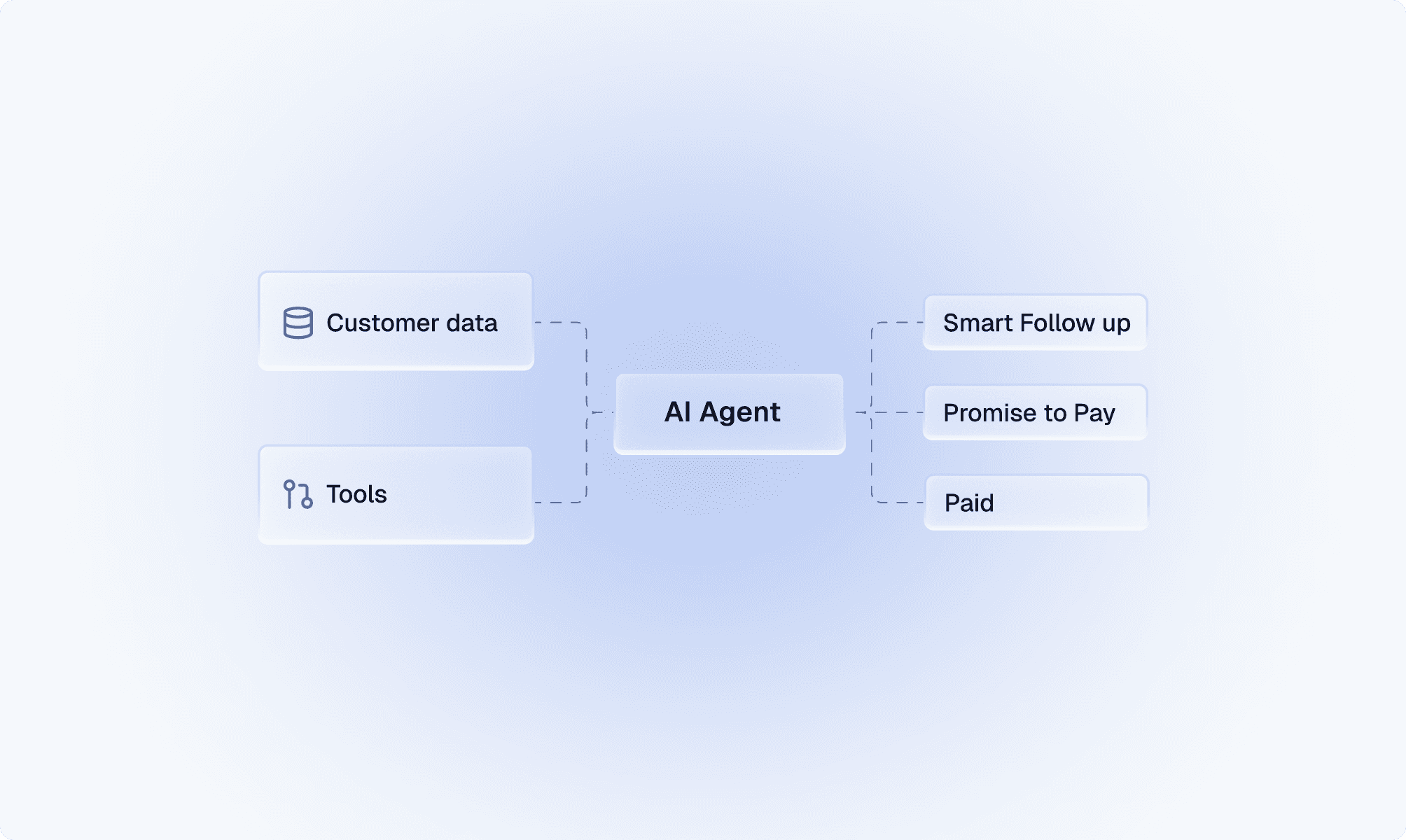
For decades, the standard response to rising delinquency rates has been a linear increase in call center headcount. This strategy has reached a point of diminishing returns: adding more humans to a collection operation does not solve the issues of emotional friction, scheduling restrictions, or compliance variability. On the contrary, it merely scales operational costs (OPEX) without guaranteeing a proportional return in liquidity.
We face an operational paradox: customers expect seamless digital experiences across all financial services, except in collections, where they are still subjected to intrusive, analog approaches.
The solution to breaking this cycle is not more automation in the classic sense of static dunning rules. The solution lies in Agentic AI. Unlike passive software, a debt collection AI agent acts as an autonomous financial recovery asset, capable of navigating the complexity of debt negotiation with the precision of an algorithm and the adaptability required to preserve the customer's Lifetime Value (LTV).
What is a debt collection AI agent?
Most debt collection technologies still operate as linear workflows. A message is sent, a response is logged, and a follow-up is scheduled based on static rules. AI agents fundamentally change this model by introducing a continuous decision loop that learns, adapts, and optimizes every interaction in real time.
At the core of modern agentic debt collection is a closed-loop system built around three tightly coupled capabilities: Segmentation, Negotiation, and Optimization. This is not a one off campaign. It is a living system that improves with every customer interaction.
1. Dynamic Segmentation, from cohorts to individuals
The process begins with segmentation, but not in the traditional sense of fixed buckets or personas. AI agents start with common attributes such as debt size, repayment history, demographics, and behavioral signals. As conversations unfold, segmentation continuously refines itself until each debtor is effectively treated as a segment of one.
For example, two customers with the same outstanding balance may diverge quickly once one indicates temporary job loss while the other signals willingness to settle immediately. The agent updates context instantly and adapts its strategy accordingly. Segmentation becomes a moving input, not a static setup step.
2. Adaptive and empathetic negotiation, in real time
Negotiation is where AI agents move beyond automation into true agency. The agent initiates outreach using the optimal channel and tone, whether that is WhatsApp, SMS, voice, or email, guided by compliance rules and business policies.
Crucially, negotiation is not scripted. If a debtor rejects an initial proposal, the agent does not wait days for human intervention or trigger a generic follow-up. It evaluates the response, updates the context, and dynamically proposes a counteroffer within predefined guardrails.
For example, an agent may start with a lump sum settlement. If resistance is detected, it can pivot to installments, adjust discounts, or change messaging tone, all while remaining compliant and empathetic. The goal is not pressure. It is resolution through relevance and timing.
3. Continuous optimization through next best action
Every interaction feeds into an optimization layer driven by a Next Best Action decision engine. After each message, payment, or silence, the agent decides what should happen next.
That decision may be to follow up immediately, schedule a reminder for a specific day and time, switch channels, adjust tone, activate a new payment option, or stop entirely and escalate to a human with clear reasoning. All decisions respect policy constraints such as quiet hours, opt-outs, regulatory limits, and budget caps.
Importantly, outcomes are not just executed. They are learned from successful negotiations and reinforce future strategies. Failed attempts inform better timing, messaging, and offers. Over time, the system becomes materially better at predicting what will work for each individual.
→ Watch our Voice Agent demo and witness the level of empathy and reasoning speed during a debt renegotiation:
Why this matters for business leaders
This agentic approach transforms debt collection from a cost center driven by volume into a performance engine driven by intelligence. It reduces time to payment, increases recovery rates, lowers operational overhead, and improves customer experience, all while maintaining strict compliance.
Instead of asking, “Did we send the message?”, leaders can ask, “Did we take the best possible action for this customer, at this moment, under our policies?”. AI agents make that question actionable at scale.
What emerges is not automation. It is an always-on, self-improving negotiation system that treats every customer interaction as a strategic decision, not a workflow step.
Why AI agents are better than chatbots in debt collection
There is a terminological confusion in the market that proves costly for enterprises. Executives often implement chatbots expecting AI results, and frustration is inevitable. When analyzing why AI agents are better than chatbots in debt collection, the fundamental difference is the capacity for resolution versus triage.
The Chatbot (Decision Tree): It is static. It follows a pre-programmed script. If a client says, "I lost my job", the chatbot freezes or offers an irrelevant generic response, forcing a handover to a human. The chatbot is a barrier, not a solver.
The AI Agent (LLM and Context): It is dynamic. It combines LLM-level language understanding with customer context, policy guardrails, and a Next Best Action engine. If a client mentions unemployment, the agent interprets it as a new context and adapts the strategy: change tone, switch channel, schedule a more appropriate time, or propose an alternative plan, as business rules permit.
What makes this difference real in collections?
An AI agent is not a single conversational interface. It is a system that connects segmentation, negotiation, and optimization into a closed loop. After every interaction, it decides what to do next, executes safely, and learns from outcomes. This is how collections shifts from “sending messages” to “driving recoveries.”
Proof of Efficiency at Scale: In the telecommunications sector, Mobi2Buy leveraged Moveo.AI's agent technology to automate collections for the fourth-largest operator in Latin America. The practical result of this technological distinction was measurable: AI agents proved to be 2x more efficient in debt collection than common chatbots. While chatbots merely delivered messages, the agents effectively negotiated and closed deals.
How AI agents make debt collection easier and more efficient
True operational efficiency in credit recovery is measured by the speed at which we transform stagnant receivables into free cash flow, without increasing management complexity. AI agents transform collections into applied data science by operationalizing the Segmentation, Negotiation, Optimization trifecta as an always-on operating model.
1. Scale with Personalization (The Mobi2Buy Case)
The biggest human barrier is the inability to personalize at scale. A human cannot maintain empathy and technical precision after 100 calls. AI agents do not suffer from fatigue. Returning to the Mobi2Buy case, the implementation allowed for the management of 200,000 conversations per month with a resolution rate of 76%. Of these contacts, an average of 51,000 users settle their debts monthly. This demonstrates how AI can maintain a high standard of negotiation (personalized) even at massive volumes.
2. Increased Recovery Rate and Reduced OPEX
Market data corroborates what we see in practice. Institutions adopting AI strategies report increased recovery rates. According to reports from RTS Labs, the use of predictive analytics and AI can raise collection rates by up to 30% and reduce costs by 40%. Furthermore, Webio highlights that intelligent automation can reduce the operational cost per collected unit by up to 66%, allowing human teams to focus solely on cases of extremely high complexity.
3. Reduced Resolution Time
Speed is essential in credit recovery. The use of intelligent agents at Mobi2Buy resulted in a 2x reduction in average handling time. The agent eliminates the waiting queue, verifies identity instantly, and gets straight to the point of negotiation, respecting the user's time.
Transforming compliance into a scalable operational advantage
In a corporate environment, regulatory compliance is the bedrock of operations. While human teams are irreplaceable in complex negotiations requiring discernment and deep empathy, the repetitive execution of regulatory scripts at scale can generate fatigue and operational inconsistencies.
The AI Agent acts as a protective shield for the operation. It is programmed to strictly adhere to regulations (such as FDCPA in the US, or GDPR in Europe), ensuring that every disclaimer is read and that no rules regarding timing or tone of voice are violated. This mitigates legal liability risks and allows human operators to focus their cognitive energy where it is most valuable: resolving critical cases and managing exceptions.
→ Learn more: Why LLMs are addicted to pleasing you (and not built for the truth)
The inevitability of the Agentic economy
The financial market no longer accepts inefficiency as a standard cost of doing business. Institutions that insist on purely manual models or simple automation are, in practice, choosing to absorb growing opportunity costs.
The technology demonstrated by cases like Mobi2Buy proves that it is possible to elevate recovery rates while reducing customer friction. Therefore, the adoption of Agentic AI is the logical step for those seeking to protect capital and ensure the long-term sustainability of the operation.