How to improve Customer Experience in Financial Services

Moveo AI Team
in
🏆 Leadership Insights
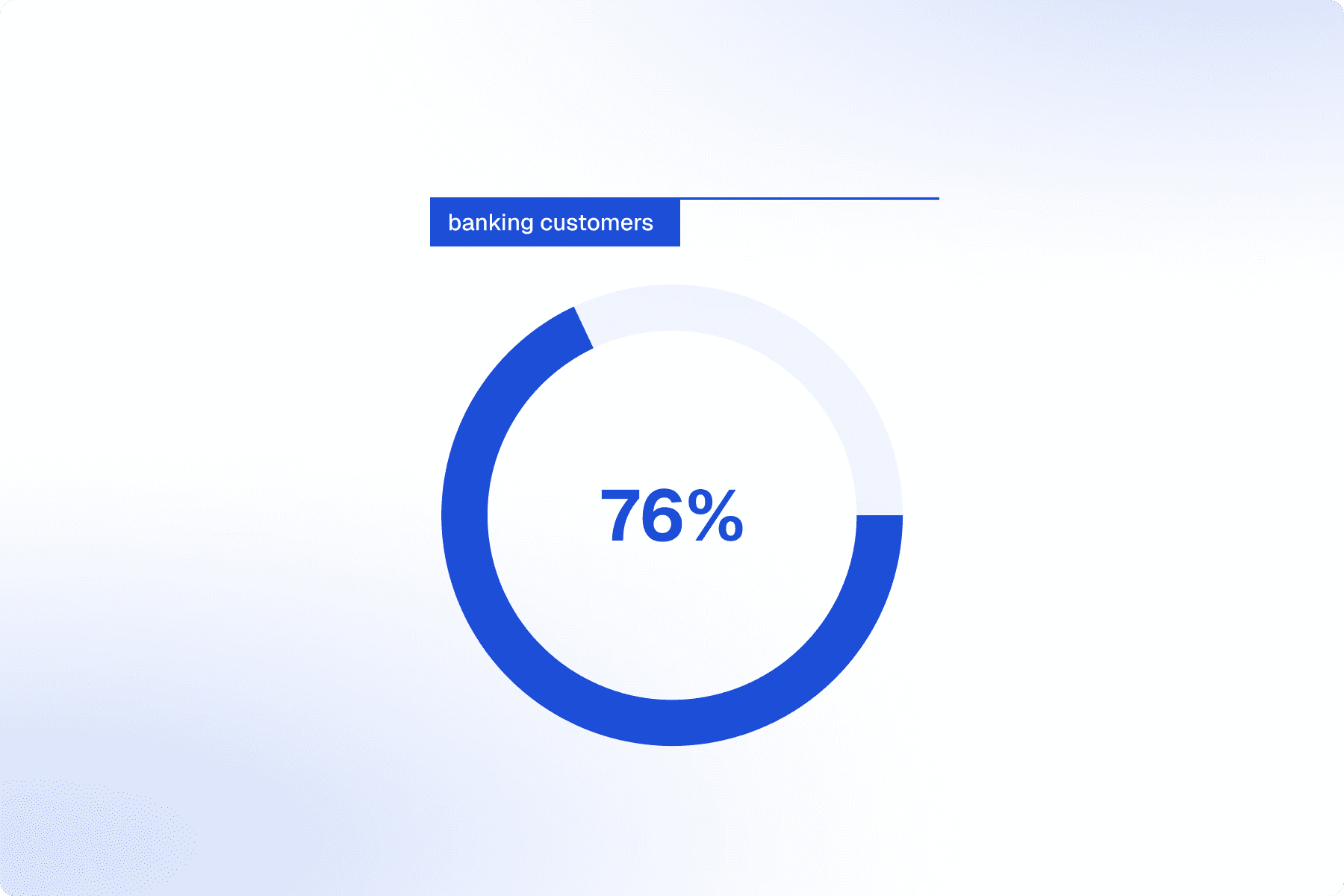
According to a 2024 Motley Fool survey of over 2,000 banking consumers, 76% said they would likely switch banks if they found one that better met their priorities, up from 52% in 2020. And yet acquiring a new customer still costs up to five times more than retaining one, which makes the gap between what customers expect and what institutions actually deliver one of the most expensive problems in financial services today.
The gap rarely closes because of a single dramatic failure. It widens through fragmented operations: customer service resolves the day's issue, accounts receivable manages next month's payment, and collections handles what slipped through, each function operating on a partial view of the same customer.
The question is not whether financial institutions understand this. Most do. The question is how the ones that are actually closing the gap are doing it.
Why CX leaders in Financial Services outperform their peers
The performance difference between CX leaders and laggards in financial services is not marginal. McKinsey research shows that the top quartile by Net Promoter Score outperforms the bottom quartile by 72 percentage points in shareholder return. That gap compounds over time through higher retention, more cross-sell opportunities, and lower cost to serve.
The mechanism is straightforward: customers who feel known by their institution stay longer, escalate less, and are more likely to resolve payment issues without adversarial intervention.
Deloitte research across 17 countries found that 70% of banking customers consider consistency across channels extremely important when choosing an institution. When that consistency is absent, the relationship deteriorates at every handoff, not from any single failure, but from the accumulated cost of starting over.
Four strategies that improve Customer Experience in Financial Services
1. Treat onboarding as revenue infrastructure
The customer relationship does not start at the first service call. It starts at onboarding, and research with 600 financial executives suggests that approximately 70% lose clients due to inefficient onboarding processes. The friction is rarely dramatic. It is usually unclear guidance, missing feedback, or unexplained delays that signal to a new customer what the relationship will feel like for years to come.
Beyond reducing friction, onboarding is the first opportunity to build a customer context record: preferences, product usage, communication habits, and declared financial situation.
When that information travels forward into every subsequent interaction, the institution compounds its understanding of the customer over time. When it does not, each function that touches the customer starts from zero.
2. How personalization in banking actually works
McKinsey data shows that 71% of banking customers expect personalized interactions, and institutions that close this gap generate 40% more revenue than those that do not. Most institutions already have the data. The problem is that it sits in systems that do not share it at the moment of interaction.
A customer calling about a billing dispute should not have to explain their account history to the agent. A collection's outreach should not ignore the service complaint filed two days earlier. Effective personalization in financial services means that every person who touches the customer, human or AI agent, picks up the conversation where the last one left off, rather than starting it over.
3. What omnichannel really means for customer retention
Zendesk research shows that 70% of customers expect support agents to have full context from prior interactions. When they do not get it, the customer becomes the institutional memory, responsible for re-explaining their situation every time the channel changes.
True omnichannel integration means context travels between touchpoints: the chatbot interaction informs the branch visit, the service call informs the follow-up communication, the complaint filed on Tuesday informs the collections contact on Thursday.
Banks that achieve this level of continuity see 20% better retention than those that treat channels as separate systems.
4. Customer Experience during delinquency is the highest-stakes moment
Most CX frameworks stop at service quality and digital experience. They rarely address what happens when a customer falls behind on a payment, which is precisely when the relationship is most at risk and when siloed operations cause the most visible damage.
A collections contact unaware of an open billing dispute will apply pressure at exactly the wrong moment. A service team that does not know a customer is in arrears will offer solutions that conflict with what collections is already pursuing. The customer experiences this as organizational incoherence and often responds by disengaging entirely.
The institutions closing this gap are not adding more channels to their collections process. They are giving collections the same context layer that customer service operates on, so that every outreach is informed by what the customer has already communicated, committed to, or complained about.
Report: 7 Critical Capabilities for Customer-to-Cash Excellence →
Before your next CX initiative, see which capabilities separate retention leaders from the rest of the market. Download the report.
How to measure CX impact on revenue in Financial Services
This is where most CX programs stall. They generate strong satisfaction scores and then struggle to connect those scores to revenue outcomes.
McKinsey's analysis of CX transformation programs in banking shows that programs that target experience metrics in isolation, CSAT, and NPS, tend not to deliver the financial results they promise. The best programs connect three layers of data: satisfaction signals, operational signals (escalation frequency, repeat contact rate, channel switching), and financial signals (lifetime value, churn rate, Days Sales Outstanding).
When those three layers communicate, a team can identify which customers are at risk before the churn appears in standard reporting and intervene with the right action at the right moment.
Experian data puts the financial case plainly: a 5% increase in customer retention can increase profits between 25% and 95%. Retained customers compound in value. Lost customers cost far more than the revenue they represent.
How to connect Customer Service, AR, and Collections
CX leaders in financial services achieve 1.8x higher customer retention and 1.5x higher revenue growth than their competitors, not because they have better individual functions, but because those functions share a common view of the customer. Customer service, accounts receivable, and collections operate as a single loop, each informed by what the others have already learned.
This is what agentic AI in financial services makes structurally possible: AI agents with a persistent memory layer across the full Customer-to-Cash cycle, where what a customer tells service on Monday informs what collections knows on Thursday, and the dispute registered in AR adjusts the payment approach before the next outreach. Every interaction builds on the last rather than resetting it.
Three diagnostic questions identify where this coordination is missing:
Which customer journey concentrates the most friction and has the most direct impact on retention?
Does customer context travel between Customer Service, AR, and Collections, or restart at every handoff?
Are CX metrics connected to financial outcomes, such as lifetime value, churn rate, and DSO, or tracking satisfaction in isolation?
The answers determine whether the next CX initiative compounds over time or plateaus after the first wave of improvement.
CX as a competitive architecture: moving beyond departmental ownership
The financial institutions that will lead in customer retention over the next five years are those that have solved the coordination problem: making sure every interaction, from onboarding to billing dispute to collections outreach, is informed by what came before it.
Customer experience in financial services has hit a structural ceiling when treated as the responsibility of a single team. The next level requires Customer Service, Accounts Receivable, and Collections to operate with the same memory, the same context, and a shared understanding of each customer's history. When that coordination exists, every customer interaction builds the next, and every interaction drives revenue.
Book a Demo → See how Moveo.AI connects Customer Service, AR, and Collections into a single intelligence layer — and what that means for retention and cash flow in your operation.