Every customer interaction already contains your next dollar (and most people miss it)

Moveo AI Team
in
🏆 Leadership Insights
Within three weeks, the same customer at a financial services company can speak with the support team about a billing question, receive a payment reminder from accounts receivable, and then get a collections call as if neither of the two previous conversations had ever happened.
Every team did its job, but the customer, however, is left feeling like the company does not know who they are.
That disconnect costs more than a poor experience. According to McKinsey (2024), revenue generation grew from 5% to 33% of customer care leaders' top priorities over just seven years.
Customer service has stopped being treated as a cost center and started being recognized as a strategic asset. The challenge is that most operations have not been redesigned to actually capture that value.
Three teams, three views of the same customer
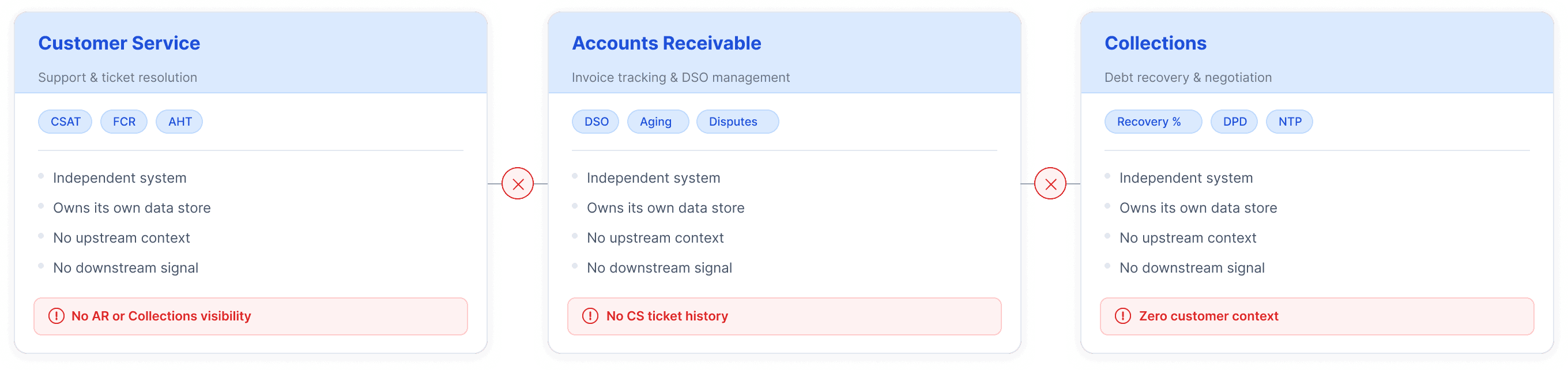
Customer Service (CS), Accounts Receivable (AR), and Collections are, in most enterprises, separate functions divided by different systems, KPIs, and work cadences.
CS tracks satisfaction, AR tracks days sales outstanding (DSO) and Collections tracks recovery rates. Each metric makes sense within its own scope, but none of them captures the value lost in the gaps between functions.
Consider the customer from the example above. They opened a CS ticket disputing a billing charge. The agent logged the case, promised a follow-up within 48 hours, and closed the ticket as "under review". The AR system, however, has no visibility into that record. The due date remains active, the automated reminder fires, and three days later, Collections reaches out with a standard delinquency script.
The customer, who was waiting for a resolution, received a collections call. What the company registers is a delinquency case. What actually happened was an internal communication failure.
That kind of breakdown is not an isolated incident. According to the Hackett Group (2024), U.S. companies hold $1.76 trillion in working capital tied up in inefficiently managed receivables.
A significant share of that figure represents situations that could have been resolved on first contact if the right information had reached the right team.
When the data exists but never reaches the people who need it
Fragmentation, in most cases, is not a shortage of information. It is a breakdown in continuity between the information each function already produces.
The customer who mentioned financial hardship in a support chat provided the most relevant data point for calibrating the next collections approach. The customer with a two-year perfect payment history who slips up for the first time deserves a different strategy than one with a recurring pattern of delinquency.
When those signals stay locked inside CS ticket systems, the collections team operates without that context, and the opportunity for a more effective approach is lost with them.
Every interaction already contains the data to make the next one more precise. The challenge is getting that context to travel across functions without disappearing at system boundaries.
The conversation as a strategic asset
Every customer interaction produces three types of signals with direct value for the other functions:
Risk signals (propensity to default, declared financial context);
Intent signals (billing objections, willingness to negotiate, preferred channel);
And relationship signals (behavioral history, prior commitments, contact patterns over time).
When those signals are captured and shared across CS, AR, and Collections, each interaction feeds the next.
The agent handling a customer today starts from what the support team learned last week. Tomorrow's collections outreach is calibrated by the context built over the course of the relationship, not by a generic segment profile.
CS starts identifying risk before it becomes delinquency. AR prioritizes disputes based on behavioral patterns, not just days past due. Collections applies a reason-aware strategy shaped by what that specific customer has already communicated.
None of these capabilities requires more data. They require the data that already exists to reach the people who need it.
→ Learn more: Why AR teams are the biggest untapped opportunity for AI
How Moveo.AI runs this loop in practice
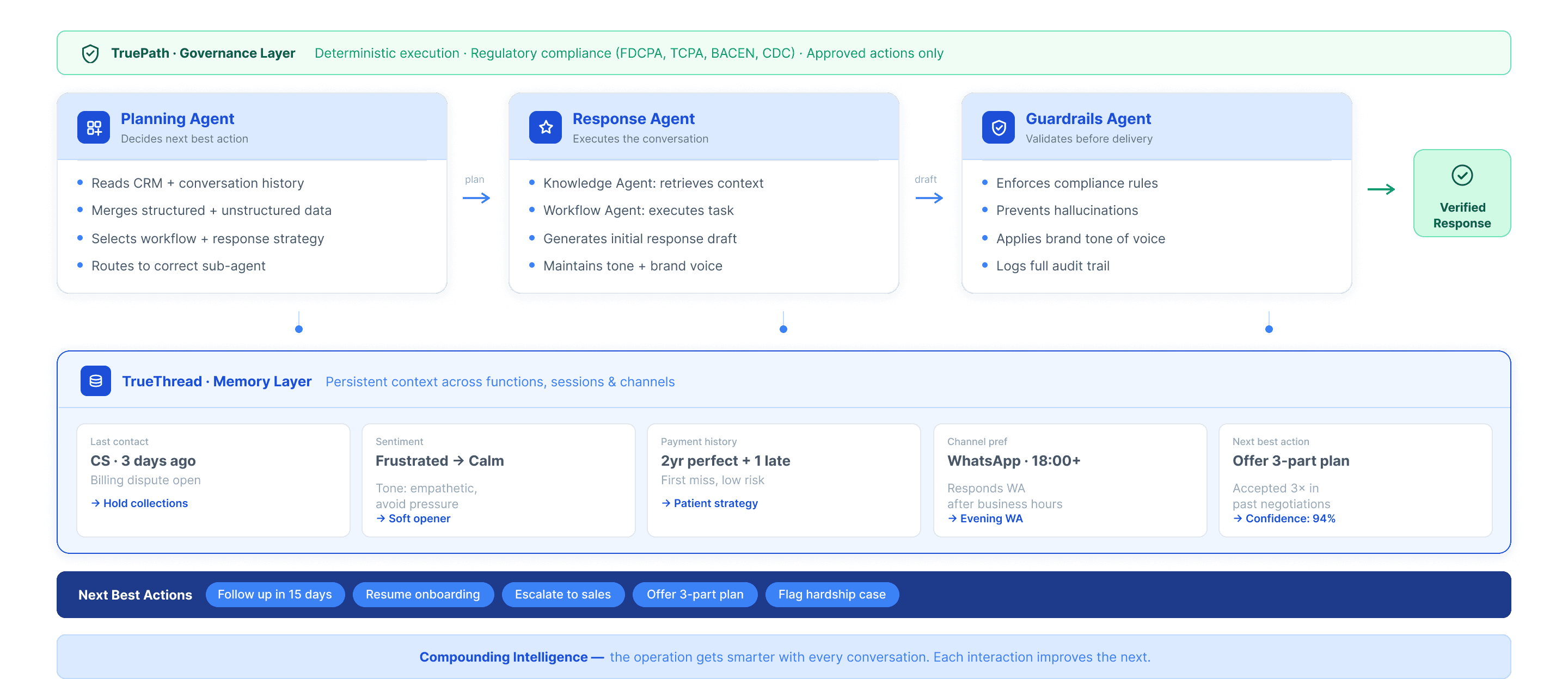
Moveo.AI was built on the premise that CS, AR, and Collections need to share intelligence, not simply automate conversations in isolation. Two components underpin this architecture.
TrueThread: memory that compounds across functions
TrueThread is the persistent memory layer that connects every customer touchpoint, regardless of which channel or function handled it.
It goes beyond conversation history: it captures sentiment, business context, declared blockers, and prior commitments, all composed into a continuous record that the next agent inherits automatically.
In practice, that means the collections agent knows this customer reported a technical issue ten days ago, prefers to be contacted on WhatsApp after 6 PM, and has agreed to a three-installment payment plan in the last two negotiations.
That context does not need to be manually retrieved or asked of the customer again. It is available from the first second of the conversation.
TruePath: governance that keeps compliance intact at scale
TruePath is the deterministic execution layer that ensures every automated action respects internal policies, regulatory requirements, and necessary approvals before it is carried out. In environments governed by the FDCPA, TCPA, or CFPB regulations, this layer turns scale into operational safety.
Before any response reaches the customer, a Guardrails Agent reviews the content: verifying compliance, correcting inconsistencies, applying brand tone, and eliminating the risk of inaccurate statements. The system does not just respond fluently. It responds responsibly.
The result of this combination is more than operational efficiency. At Moveo.AI, we call this Compounding Intelligence: the operation becomes smarter with every conversation, accumulating context and improving outcomes continuously, without requiring manual intervention at each cycle.
The loop in motion: from first contact to closed payment
Back to the opening scenario: the customer who disputed the invoice.
With TrueThread active, the CS ticket is immediately visible to AR and Collections. The system flags the account as "dispute under review" and automatically holds any standard collections action while resolution is in progress. When AR resolves the dispute, TrueThread updates the record with the outcome and the reason.
If the customer still has a balance after resolution, Collections receives the case with full context: the dispute history, the customer's preferred channel, the best time to reach them, and their documented response pattern to installment offers.
The agent does not open the conversation as a standard collections call. They start by acknowledging that the issue was resolved, then present repayment options based on what this specific customer has already shown they will accept.
The interaction that, in a siloed model, would have created friction and likely churned the customer instead closes as an agreement. The loop closes. The system learns. The next interaction starts from a more informed position.
To understand how this architecture compares to LLM-only solutions, read LLM Wrappers vs. Moveo's Multi-Agent AI.
When every interaction compounds, results multiply
Companies that redesign CS, AR, and Collections as a continuous intelligence chain do more than collect more efficiently. They retain more, resolve disputes before they become delinquencies, and build a data asset that grows with every conversation.
The operation becomes more precise over time, not despite the volume of interactions, but because each one contributes to the system.
According to Google Cloud (2025), among companies that have already deployed AI agents in production, 71% report revenue growth. What separates those capturing that value from those that are not is, in large part, how those agents are connected to the functions that already have direct contact with the customer.
The customer conversation is not the end of an interaction. It is the beginning of the next one. And the quality of the next one depends entirely on how much the system retained from the one before.
Turn every conversation into revenue
See how CS, AR, and Collections operating as a shared intelligence loop change the outcomes of your operation. Book a demo →